Saturday, June 15, 2013

Crab Collages


Materials:

White paper 9X12
Beige paper
Red felt
Scrap paper
Buttons
Beads
Leaves
Strips of mat board
Sand

1. Cut the beige paper into 3 inch wide strips. Have students tear the strips down lengthwise to give it an uneven look. This will be the sand at the bottom.
2. Cut the 9X12 felt in half. Give each student a half. They will cut an oval shape, or they can trace an oval template, and cut out.
3. Glue the sand strip at the bottom of the white paper.
4. Glue the oval felt shape right above the sand.
5. Have various small pieces of scrap paper. Students will cut out rings and circles and glue them onto the crab body.
6. They can cut several triangle shapes for the legs, and glue those on the sides. Crabs have eight legs, but it might be difficult to fit them all, so they could do 3 on each side.
7. Apply glue across bottom of beige paper, sprinkle sand over it, let dry.
8. Add buttons and beads for the eyes.
9. Cut strips of mat board very thinly on a paper cutter. Cut to be about 4 inches long.
10. Glue these on for antennas.
11. Gather some leaves that would work for the crab claws. Press them in a book overnight to help keep them from drying out. (I learned the hard way, if you don't do this, the leaves will crumble after they are glued on)
12. Cut the leaves in half, and glue on to make the claws
13. Apply ModPodge on the leaves to help preserve them.


Saturday, February 2, 2013

Sharks!


    I found the idea for this project here


 I did this project with Kindergarten
Materials:
 
White paper 9X12
Grey paper
Light blue paper
Blue watercolor
White pastel
Black marker
 
1. Have students draw little waves on the white paper with the white pastel
2. They will paint over the paper with the watercolor, and the waves will show through.
3. They can cut about 3 inches off of the paper, and glue onto the lt. blue paper.
4. Provide a tear drop size template about 4 inches long for the shark. (Or, you may let them free draw the shape)
5. Cut out and glue onto blue watercolored paper at the top.
6. Add a fin at the top and sides.
7. Add a white smile shape.
8. They draw the black eyes and zig zags for the teeth.


Saturday, November 24, 2012

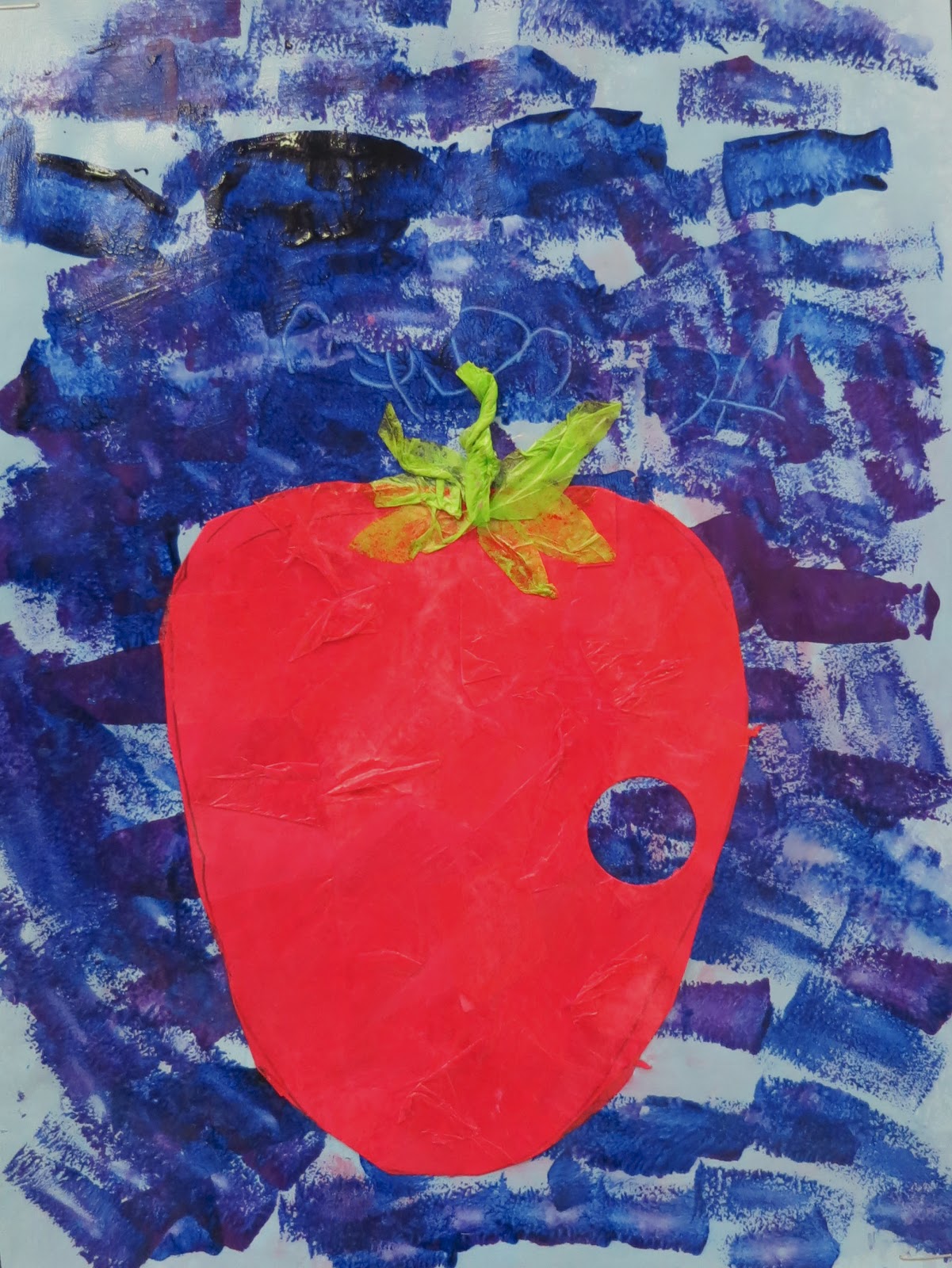
Caterpillar's Fruit


    I found this idea here. Very cute, and also has opportunities to bring in other concepts, which is a great thing about book based lessons.
 
         We read "The Very Hungry Caterpillar" by Carle. We discussed topics such as healthy and unhealthy foods and what is a good food for a caterpillar. We made a list and drawings of the healthy fruits, and counted how many the caterpillar ate. After the project was complete, we ate some fruit just like the caterpillar!
 
Materials:
9X12 colored paper
5X7 colored paper
Tempera paint
Tissue paper squares
 
1. Let the students choose the fruit they would like to make, and give them a 5X7 paper in the appr.color of the fruit.
2 You can provide templates for the fruits, or let them draw it themselves. Draw and cut out. Use glue and water to brush on tissue paper squares on the fruit.
3. Give students a choice of a contrasting color from their fruit. This will be the 9X12 paper.
4. Sponge or dab paint on paper in an analogous color to the paper.
5. Punch a hole into the fruit.
6. Glue the fruit onto the background paper and add stems and leaves.


Scribble Scrabble Chickens

I frequently hear myself saying to my students "and remember, no scribble scrabble." Most students don't intend to do it, but just forget to take the time to color solidly. However, there are times, when a scribble look is desired. These chickens (or could be any bird) are great for younger students.

Materials:

9X12 paper (I used tan, for a more rustic look)
Rust/orange paint
Yellow paper
Brown or white paper for egg

    1, Demonstrate to students how to go back and forth in different directions with the brush on the paper, starting in the middle. (Take it away before they do too much)
    2. Let dry and add a small yellow triangle for a beak and yellow strips of paper for hay.

 
    3. Add a brown or white egg to complete the nest!


Wednesday, September 5, 2012

Art "Junk" Wreath


The eternal art teachers habit: saving stuff! As my students have used up markers, I have saved the lids, knowing that somehow, someday I would use them for something. I wanted to make a new sign for my room, so I decided to make a wreath.
 
 
1. Get a styrofoam wreath; whatever size you wish. You may want to cover it with fabric or paint it, just to cover up the white styrofoam. I used some blue ribbon I had already.
 
 
2. Glue on marker caps.
 
Glue caps to the top and inside circle around the wreath.
 
I made a "bow"  from caps, then glued on used colored pencils on the top. I attached a ribbon to the back for hanging and some small letters attached with colored wire. Get a wreath hanger and hang!
 

Craft Stick Puzzles


1. Use wide craft sticks. You may wish to paint them.

2.Choose a favorite art image and print it to appr. 5X7 size.
Also print a wallet size image for the front of the box.


3. Cover with clear contact paper to help them last longer. You can also varnish the sticks.

 
 4. Line up the sticks straight. Glue the image onto the sticks. Let dry


 5. Turn the glued sticks upside down, and using an exacto knife, cut in between each stick.


 6. Glue or tape the wallet size image onto a plastic box and place stick puzzle into box. These seem like  they would be very easy puzzles to do, but they are actually challenging, and elementary age students enjoy them. I use them as an early finisher activity.


Sunday, July 8, 2012

Simple Self Portraits


I don't know about you, but self portraits actually aren't my favorite lesson to do with young students. I have found that trying to place too much emphasis on realism and proportion in the traditional way usually ends up with more students feeling frustrated than successful. After all, faces and people are the hardest thing to draw! We look at ourselves every day, yet our left brain gets in the way and makes us draw what we think we look like, instead of what is really there. (Drawing On the right Side of the Brain, by Edwards,does an excellent job explaining this)

     Anyway, I did find a good idea on Art Projects for Kids for a simplified way to do self portraits. It simply uses a circle for the head shape, and allows the students to draw simple lines for the nose and mouth.

Materials:

Circle templates
White 9X12 paper
Rulers
Markers
Chalk pastels in skin colors

1. Have students measure a one inch border around the paper, then a 1/4 inch inside that. (I have found that measuring is one of the most challenging tasks for students, but a good learning opportunity for them.)

2. Students will trace the circle template exactly in the middle of the frame.

3. Eyes- This project gives the big eye look, but if you prefer, you can do the eyes in regular proportion. You can provide a template or not. Instruct to draw a football shape, round iris, and round pupil. It is important to get the eyes evenly spaced and the same size.

4. Draw a small curved line for the nose.

5. Draw a "flying bird  shape" for the mouth. Girls can draw lips, and boys can draw just a curved line for the mouth. No teeth!

6. Draw diagonal lines down from the head for shoulders.

7. I find that chalk pastels work best for shading in faces. They can blend it in with their finger, so their are no scribble lines. If students have darker skin, have them build the color slowly, so it is more even.

8. Students can use colored pencil or a light peach/pink marker for the nose and mouth.

9. Hair- Oh hair! Challenging! I found the best luck with coloring in lightly with a light cream chalk pastel, and then brown, darker brown, in layers over the top. more yellow/white for blondes. They can make some of the hair go out of the frame slightly. Instruct to make the hairline long enough and not forget the sides of the head. For students with short hair, or pony tails, don't forget to draw ears!

10. Clothes, they can color those any way they wish.

11. Background and frame can also be colored in whatever colors they wish.

12. They can write their name at the bottom, and color in with marker.